
Article drafted by the SPA/RAC and MedPAN
In 2025, 263 managers of Mediterranean Marine Protected Areas (MPAs) completed a survey to share their experiences as part of the preparation of the Report on the Status of Mediterranean MPAs 2025. Their responses enable an assessment of the extent to which 12 key conditions, recognised as essential for effective management, are met.
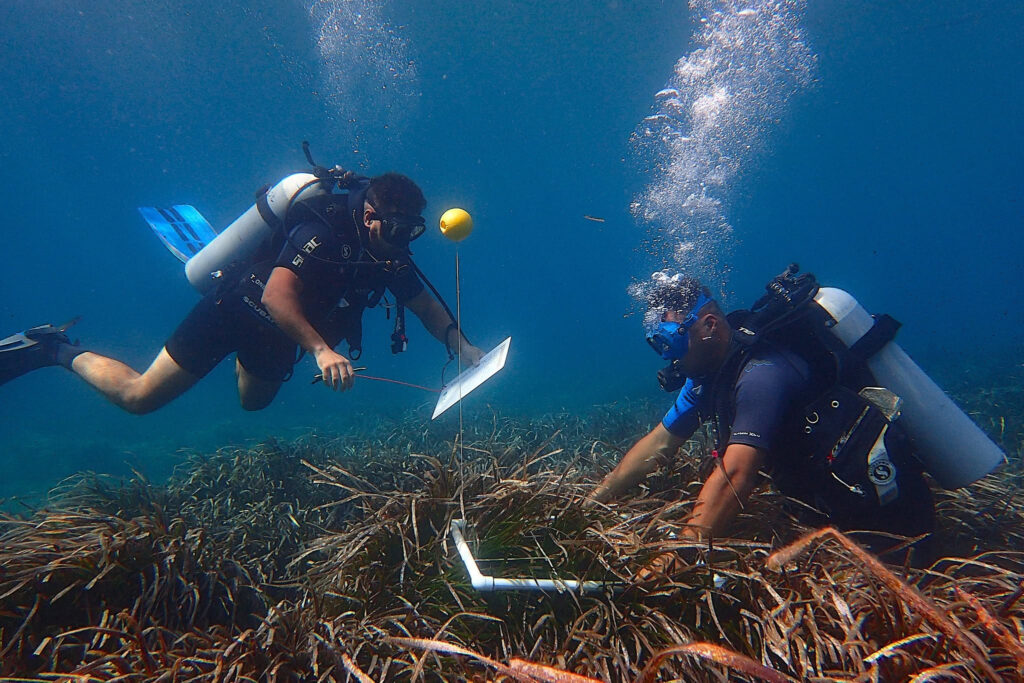
(Taza National Park in Algeria, © Association Écologie Sans Frontière)
12 key conditions carefully examined
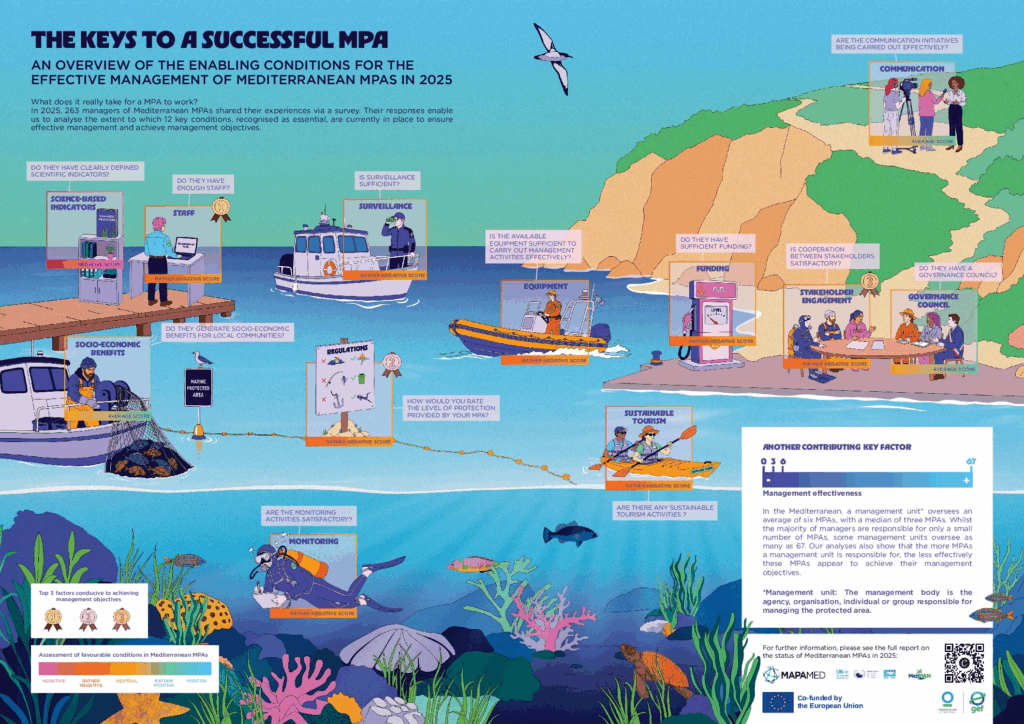
For each of these conditions, a question was asked to managers: Does the MPA have sufficient staff? Does it have an adequate budget and suitable equipment? Are surveillance and monitoring activities satisfactory? Do stakeholders cooperate? Is there a governance council, clearly defined scientific indicators, well-executed communication initiatives, sustainable tourism activities or socio-economic benefits for local communities? And finally, how is the level of protection within the MPA assessed?
The managers’ verdict is expressed as a score, ranging from ‘negative’ to ‘positive’, a result calculated from the average of the responses to the corresponding question.
A key finding: none of the conditions achieved a positive score
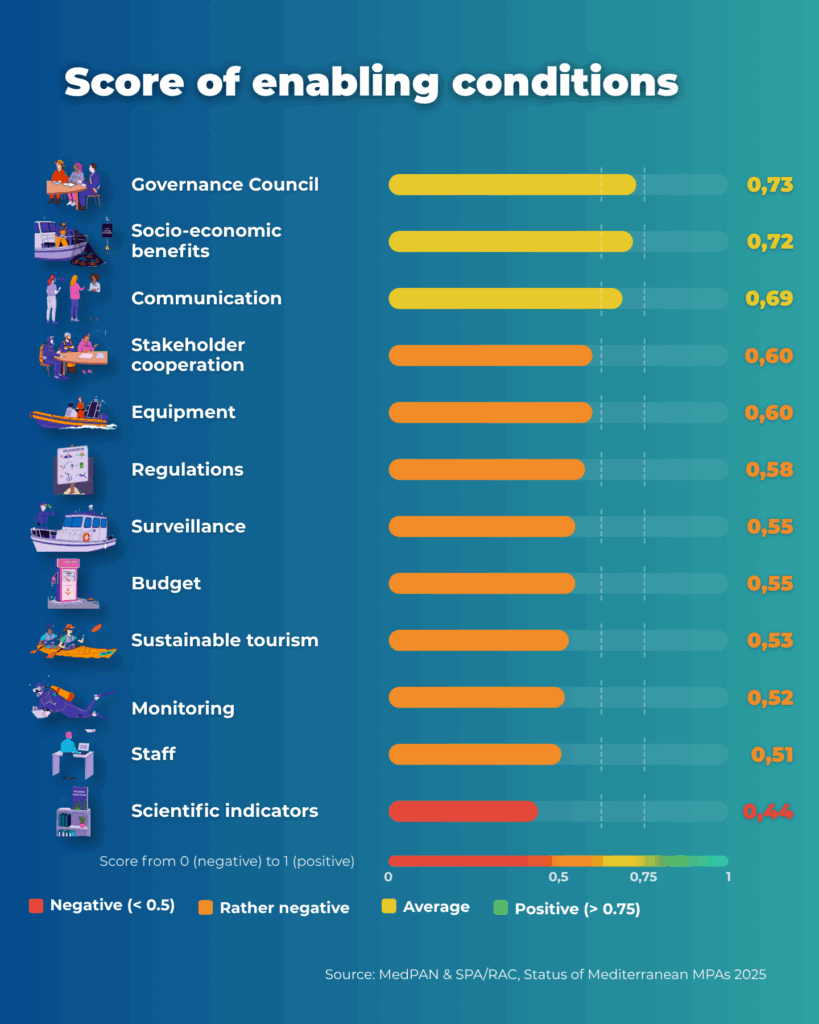
The overall assessment calls for urgent action: currently, no condition achieves a fully positive score across the Mediterranean:
- 🔴Red alert (Negative score): The main area of concern relates to science-based indicators, which have the lowest score (0.44).
- 🟠Orange zone (Somewhat negative score): Shortages of staff, monitoring, lack of equipment, tight budgets, overall scientific monitoring, sustainable tourism, stakeholder engagement and the actual level of protection for the areas represent major sources of vulnerability.
- 🟡 In the yellow zone (average score): Communication, the functioning of governance councils and socio-economic benefits for local communities score higher than the other indicators, but need to be strengthened.
The top three drivers to reverse the trend
To maximise the impact of MPAs and achieve the set objectives, three key priorities stand out:
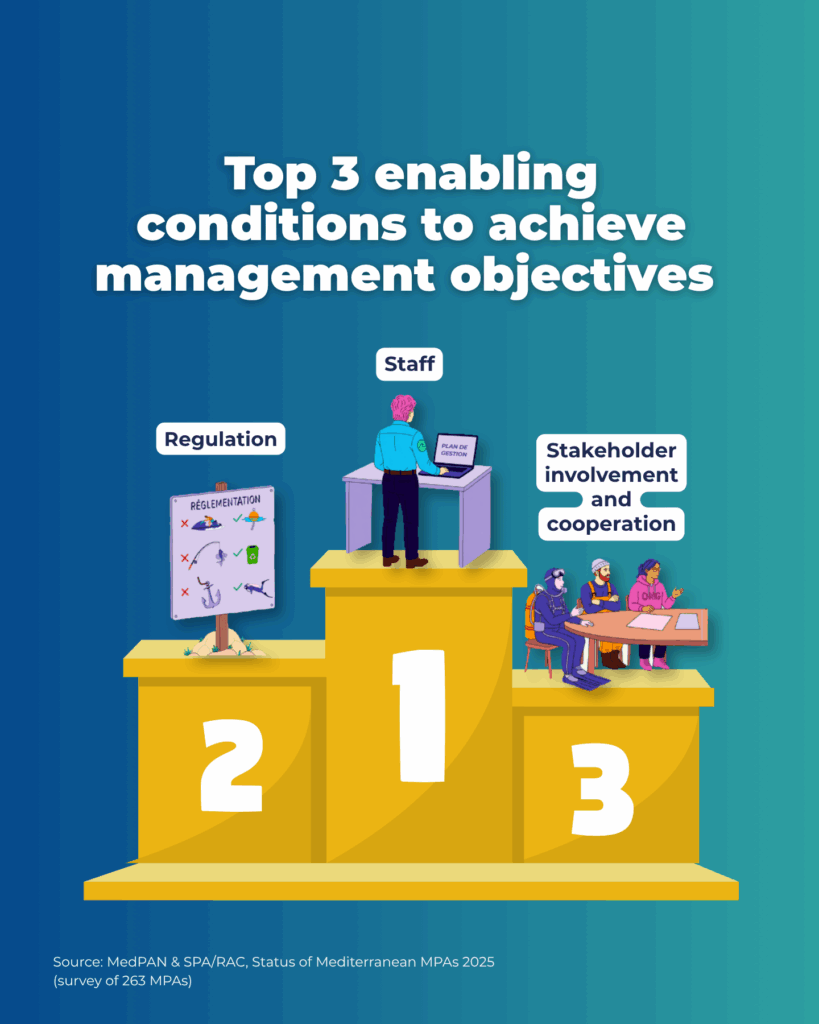
Among these 12 conditions, three stand out as particularly conducive to achieving management objectives:
- Staff: Having sufficient staff is the cornerstone of effective management.
- Level of protection: There is an urgent need to expand the area of MPAs benefiting from the highest levels of protection (based on the standards of the MPA Guide).
- Stakeholder involvement: Ensuring that all local stakeholders (fishermen, users, institutions, associations, etc.) work hand in hand is a decisive factor.
The pitfall of fragmentation: the ‘management unit’ effect
The analysis highlights another factor that is often overlooked but crucial: the role of the management unit (the body responsible for managing the site).
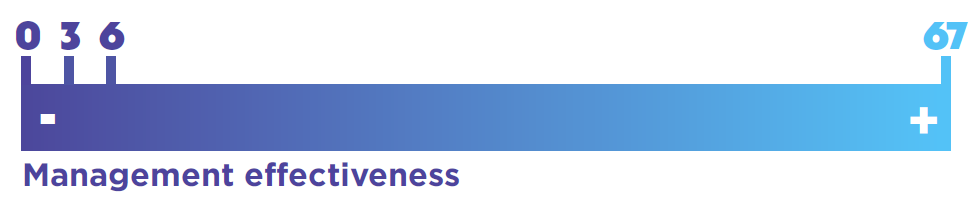
In the Mediterranean, a management unit oversees an average of 6 MPAs (with a median of 3). However, some teams have to manage as many as 67 at a time. The figures are clear: the more sites an organisation manages, the less likely it is to achieve its management objectives.
Looking to the future
This snapshot of the year 2025 provides us with a clear roadmap for action: strengthening teams, securing funding and equipment, structuring scientific monitoring, consolidating governance and dialogue with stakeholders, and ensuring that the management workload remains realistic and compatible with the available resources.
Find out more
You can find all this data illustrated on the poster ‘The keys to a successful MPA’, which will be distributed at the next Mediterranean MPAs Forum in Alexandria (Egypt), from 15 to 17 December 2026. It provides an at-a-glance overview of the 12 key conditions, their scores and the role of the management unit. To find out more about the methodology, the full report on the status of MPAs will be available in December 2026.
.